
Introduction
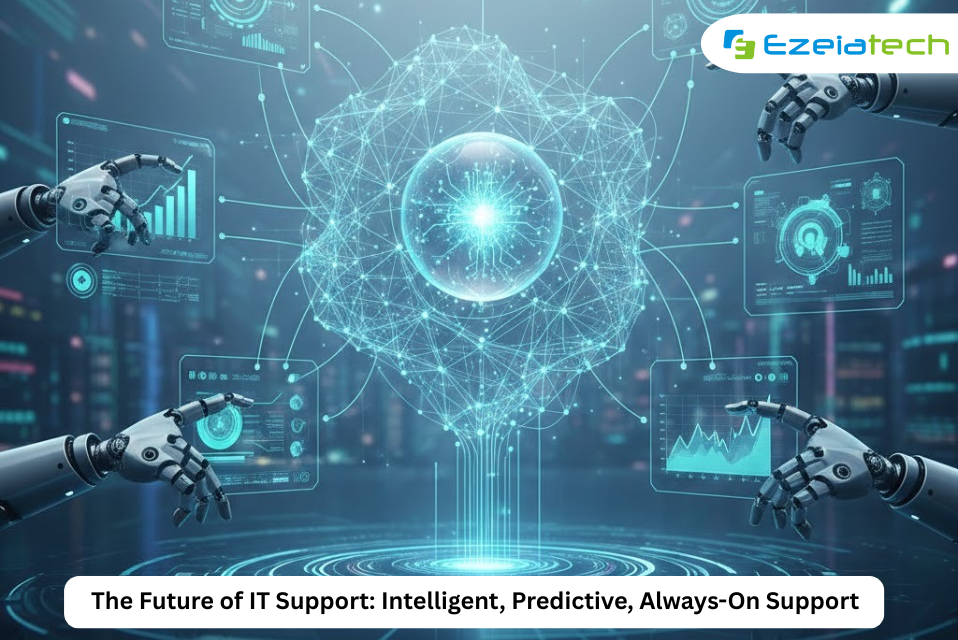
For decades, IT support has operated on a reactive model: something breaks, a user submits a ticket, and technicians scramble to diagnose and fix the problem. This “break-fix” approach is no longer sustainable in our era of distributed workforces, complex cloud environments, and relentless cybersecurity threats. The future belongs to a new paradigm: intelligent, predictive, and always-on IT support.
This evolution isn’t merely about faster response times. It represents a fundamental shift from being a cost center that reacts to problems to becoming a strategic enabler that prevents them. By leveraging Artificial Intelligence (AI), Machine Learning (ML), and automation, IT support is transforming into a proactive guardian of productivity and business continuity. This blog will explore the three pillars defining this future—intelligence, prediction, and constant availability—and the tangible impact they deliver.
The Limitations of Traditional Reactive Support
The traditional IT support model is plagued by inherent inefficiencies that hurt both productivity and morale. A 2023 study by Gartner highlights the core issue: “Downtime costs enterprises an average of $5,600 per minute,” underscoring the staggering financial impact of IT failures. Beyond cost, the reactive model suffers from:
- Extended Downtime: Time is lost while users wait for help, technicians diagnose issues, and solutions are applied.
- User Frustration: Repetitive, slow-to-resolve issues degrade the employee experience and technological trust.
- IT Burnout: Support teams are trapped in a cycle of firefighting, leaving little room for strategic projects or skills development.
- Hidden Problems: Many minor issues or performance degradations go unreported, slowly eroding system health until a major failure occurs.
This model treats symptoms, not the underlying disease. The future of support focuses on maintaining optimal health in the first place.
Pillar 1: Intelligent Support (AI-Powered Automation)
Intelligence in IT support means moving beyond scripted responses to systems that can understand, learn, and act. AI and Machine Learning power this.
Key Applications:
- AI-Powered Service Desks & Chatbots: Modern chatbots use Natural Language Processing (NLP) to understand user queries in plain language. They can resolve common issues (password resets, software installs) instantly, 24/7, and escalate complex tickets with full context to human agents. This is often called a “tier 0” support layer.
- Intelligent Ticketing & Routing: AI analyzes incoming tickets, categorizes them, predicts the required skill set, and automatically routes them to the best-suited technician, slashing resolution times.
- Knowledge Management & Self-Healing: AI can mine resolution data from past tickets to suggest solutions to agents in real-time. More advanced systems can even execute automated remediation scripts for known issues.
The Impact: According to a report by Accenture, “AI-powered automation can increase IT support agent productivity by up to 40% by handling routine tasks and providing contextual guidance”.
Pillar 2: Predictive Support (From Reactive to Proactive)
This is the cornerstone of the future IT support model. Predictive analytics uses historical and real-time data from networks, servers, and endpoints to identify anomalies and forecast failures before they impact users.
How It Works:
Predictive platforms, often part of AIOps (Artificial Intelligence for IT Operations), ingest millions of data points. ML models then establish a “normal” performance baseline. When metrics deviate from this baseline—like a server’s memory usage trending upward or a router showing increased latency—the system generates an alert. This allows IT teams to replace a failing hard drive during a maintenance window before it crashes, or add bandwidth before users complain of slowness.
The Data: A Forrester Consulting study on the Total Economic Impact™ of predictive IT found that organizations using these solutions “experienced a 75% reduction in unplanned downtime” and “a 50% reduction in time spent on incident resolution.”
Pillar 3: Always-On Support (Ubiquitous and Embedded)
The modern workforce is always-on, working from anywhere at any time. IT support must be equally ubiquitous.
Key Elements:
- Omnichannel Accessibility: Support must be seamlessly available via chat, portal, email, and even integration within collaboration tools like Microsoft Teams or Slack.
- Remote & Proactive Remediation: With tools like Remote Monitoring and Management (RMM), support can access, diagnose, and fix endpoint issues remotely, often without the user even knowing there was a problem.
- Integrated into the Flow of Work: The most advanced “always-on” support is invisible. Imagine an AI assistant embedded in your CRM that detects a performance issue and fixes it automatically, or a system that preemptively updates software on a device during off-hours based on the user’s calendar.
Traditional vs. Future IT Support: A Comparative Analysis
| Feature | Traditional (Reactive) Support | Future (Intelligent, Predictive, Always-On) Support |
|---|---|---|
| Core Philosophy | “Wait for it to break, then fix it.” | “Prevent it from breaking, and fix it silently if it does.” |
| Primary Driver | User-reported incidents (tickets). | System-generated insights & predictive alerts. |
| Response Time | Hours or days after impact. | Minutes, or proactive action before impact. |
| Automation Level | Low; highly manual processes. | High; AI handles Tier 0/1, automates remediation. |
| Team Focus | Firefighting, repetitive tasks. | Strategic projects, complex problem-solving. |
| User Experience | Frustrating, interruptive. | Seamless, minimally disruptive. |
| Business Impact | High cost of downtime, reactive cost center. | Maximized uptime, strategic business enabler. |
The Tangible Business Outcomes
Adopting this future-facing model delivers clear ROI:
- Dramatically Reduced Downtime: Preventing issues is far cheaper than fixing them. This directly protects revenue and productivity.
- Lower Operational Costs: Automation reduces the volume of repetitive tickets, allowing existing staff to handle more with less stress.
- Enhanced Security Posture: Predictive analytics can spot unusual network traffic or endpoint behavior that may indicate a security threat, enabling faster containment.
- Improved Employee Satisfaction & Retention: Both end-users (who experience fewer problems) and IT staff (who engage in more meaningful work) benefit, improving morale across the board.
Conclusion: Building Your Intelligent Support Foundation
The future of IT support is not a distant concept; the technologies to build it are available today. The journey begins with integrating data sources (network, cloud, endpoints) into a centralized platform capable of analytics and automation.
For business leaders and IT directors, the mandate is clear: investing in intelligent, predictive, and always-on support is no longer an IT luxury-it is a critical investment in operational resilience, competitive advantage, and future-proofing your organization’s digital core. The goal is to create an IT environment so robust and self-aware that support becomes a silent, seamless guarantee of continuity, freeing your people and technology to perform at their peak.